 Dan Knight
My finger was already resting on the mouse. The level I had marked over breakfast was being retested, the candle closed the way my notes said it should, and I sat there doing nothing for what the screen recording later clocked at fourteen seconds. Price left without me, and I spent the next hour pretending I had “decided” to pass.
So how do Xcelerate Trade traders handle uncertainty without freezing? They move the hard decisions to a calm hour before the session. The scenario and the invalidation level get written down in advance, the position is sized from the stop so one loss stays small, results are judged across a hundred trades, and staying out counts as a planned choice.
I didn’t believe any of that when I first read it. It sounded like the tidy advice people give when they’ve never felt their stomach drop in front of a live chart. What changed my mind was boring, repetitive practice, and most of it is less heroic than it sounds.
Why Does Uncertainty Make a Trader Freeze?
A trader freezes because the brain treats a possible loss as heavier than an equal gain, so doing nothing feels like the safest move on the table. That reflex has a name, loss aversion, and Daniel Kahneman and Amos Tversky described it in their 1979 paper on prospect theory in Econometrica. In later work from 1992 they estimated that a loss weighs roughly 2.25 times as much as a gain of the same size. No wonder my hand stalled.
There’s a second ingredient, and I underestimated it for years. Too much information produces the same paralysis as too much fear. Psychologists Sheena Iyengar and Mark Lepper showed this in 2000 with a supermarket jam display, where 30 percent of the shoppers who stopped at a table with six flavors bought a jar, against only 3 percent at a table with twenty-four.
My chart used to be that jam table. Two moving averages, an oscillator, volume, a session indicator and somebody’s custom script I had paid for, all voting at once and rarely agreeing. When four tools say yes and two say maybe, the easiest answer is to wait for one more candle. And then one more.
Memory plays its part too. After two losses in a row, the third setup arrives carrying the other two on its back. I’m not sure there’s a way to switch that off completely. What I found is that you can stop asking it for permission.
Is Uncertainty the Same Thing as Risk?
No, and the difference is more practical than it sounds. Risk is a situation where the odds can be measured, while uncertainty is one where they can’t, a distinction the economist Frank Knight drew in 1921 in his book Risk, Uncertainty and Profit. A roulette wheel is risk. Tomorrow’s reaction to an earnings report is uncertainty.
People dislike the second kind far more. Daniel Ellsberg demonstrated it in 1961 with a thought experiment built on two urns, one holding a known mix of red and black balls and one holding an unknown mix. Most people bet on the known urn even when the math gives them no reason to. We would rather face odds we can see than odds we can’t see at all.
Now bring that to a trading desk. I can’t know whether the next trade wins, and no course, indicator or mentor will ever fix that. What I can do is decide exactly how much I lose if it fails, which turns one slice of the unknown into a number. I still don’t know the outcome, but I know the price of being wrong, and that is usually enough to get my hand moving.
I think most of my freezing came from mixing the two up. I used to sit there trying to become certain about direction, which is impossible, while leaving the loss amount vague, which is entirely fixable. Backwards, really.
What Does Freezing Cost Over a Year of Trading?
Freezing costs the trades your edge depends on, and it quietly corrupts your statistics. A strategy with positive expectancy only pays if you take the setups as they come, including the uncomfortable ones. Skip the scary third of them and you are no longer trading the system you tested.
I ran the numbers on myself last year, which was humbling. Over one quarter my rules produced 41 valid setups and I took 27. The 14 I watched from the sidelines would have added a little over 9R, while my real result for those three months was 6R. The trades I didn’t take were worth more than the ones I did.
The strange thing is that none of this shows up on a statement. A losing trade leaves a red line in the account history, and a missed winner leaves nothing at all. Psychologists call it omission bias, the habit of judging harm from inaction as milder than harm from action. For a trader it means the most expensive mistake is also the one that never gets recorded.
There’s a nastier side effect. A frozen trader often turns into a chasing trader about ninety seconds later, entering late at a worse price with the stop further away. The idea is the same but the reward is cut in half, and by then I’m annoyed with myself as well.
The wider picture isn’t gentle either. The European Securities and Markets Authority (ESMA) reported in 2018 that 74 to 89 percent of retail CFD accounts lose money, based on analyses by national regulators. A study by Fernando Chague, Rodrigo De-Losso and Bruno Giovannetti found that 97 percent of Brazilian day traders who persisted for more than 300 days lost money. I quote those figures because they explain why hesitation and impulse, the two ways of leaving a plan, are so expensive.
How Do You Decide Before the Candle Prints?
You decide by writing the trade as an if-then sentence before the session opens, with the invalidation level included. If price returns to this zone and closes back above it, I buy, and if it trades below that low, the idea is dead. By the time the candle prints there is nothing left to work out, only something to check.
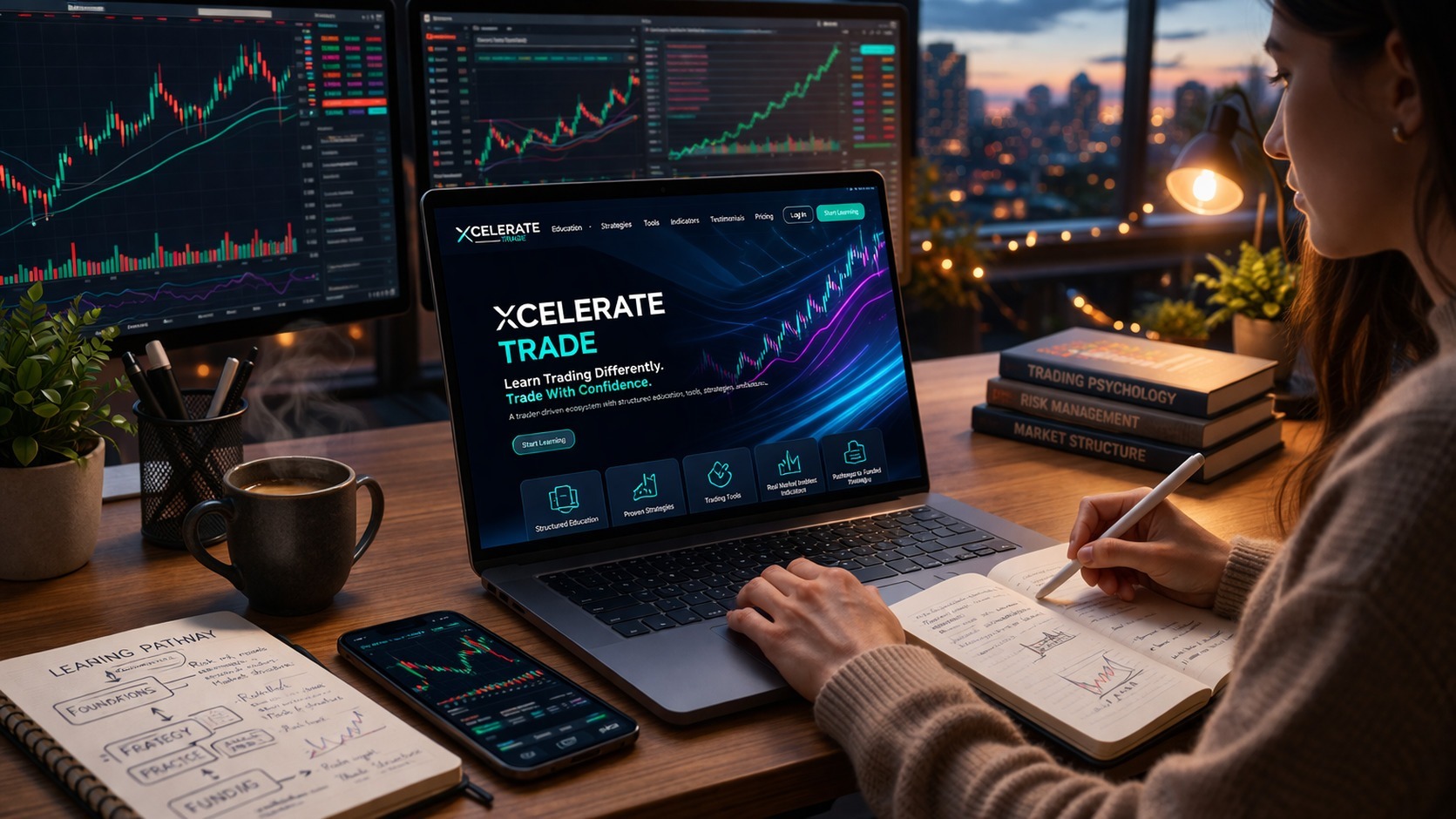
This is the part of the Academy approach that clicked for me first. Xcelerate Trade is an online trading education platform that pairs an Academy with strategies and a copy trading marketplace, available in English, Spanish, French and Romanian. Its lessons on market analysis lean on confluence, meaning several independent reasons have to line up before a trade is even considered. Fewer open questions at the moment of entry means fewer places to get stuck.
I use what I call the stranger test. Could someone who has never seen my charts read my note and place the same order I would? If the note says “looks strong, maybe long”, the answer is no, and I already know I’ll hesitate later.
Pending orders help too, more than I expected. A limit order placed twenty minutes early is executed by the platform, so the moment where my finger used to hover simply doesn’t exist. It’s a bit of a cheat and I’m fine with that, with one caveat. An order resting in the market gets filled whether or not the context has changed, so I cancel it when one of my skip conditions shows up.
How Small Should a Loss Be for the Hesitation to Fade?
Small enough that losing it would bore you. For most people that means around 1 percent of the account per trade or less, with the position size calculated from the stop distance instead of picked by feel. When the worst case is dull, the brain stops treating the entry like a cliff edge.
The arithmetic takes a minute. On a 5,000 dollar account, 1 percent is 50 dollars. If my stop on EUR/USD sits 25 pips away, I can afford 2 dollars per pip, which is 0.20 lots. A wider stop means a smaller position, and the 50 dollars never changes.
What sold me on this was the drawdown math. Lose 20 percent and you need 25 to get back, lose 50 and you need to double what’s left. Ten losses in a row at 1 percent each leave the account down roughly 9.6 percent, which is unpleasant and survivable. The same streak at 5 percent each takes away about 40 percent.
I’ll admit I resisted for a long time, because small size felt like not really trading. Then I cut my risk in half for a month as an experiment, and my skipped setups dropped from about a third to almost none. Nothing else had changed. Same charts and same rules, only with a loss I could shrug at.
A test I still use is whether I’d check the position from my phone at dinner. If the answer is yes, the size is too big for me, whatever the percentage says. Your number may be lower than mine or higher, and I don’t think there’s any shame in 0.25 percent.
Why Think in a Hundred Trades Instead of One?
Because an edge only exists across a sample, and the result of any single trade is close to random. Once I started treating each entry as one draw out of a hundred, the pressure to be right this time dropped noticeably. Mark Douglas built much of his book Trading in the Zone around that idea, that you don’t need to know what happens next in order to make money.
A quick example with made-up but realistic numbers. Say a method wins 45 percent of the time, the average win is 2R and the average loss is 1R. The expectancy works out to 0.35R per trade, so about 35R over a hundred trades, even though more than half of them lose.
Now the uncomfortable part. With a 45 percent win rate, the chance that any given run of five trades is all losers sits at about 5 percent, so across a hundred trades a streak like that should be expected. The first time I worked that out I felt oddly relieved. The losing week I’d been dreading was already in the forecast.
Our instincts fight this. In 1971 Tversky and Kahneman described what they called belief in the law of small numbers, the tendency to expect a handful of results to look like the long run. Four losses in a row feel like proof that the method is broken, when they’re well inside what the math predicts. I’ve abandoned at least two perfectly decent approaches for that reason, and I only know it because I went back and tested them later.
I sometimes think about casino owners here. They don’t tense up before each spin of the wheel, because their business is the ten thousandth spin. A retail trader has a much thinner edge than a casino and I wouldn’t push the comparison far, but the posture is worth borrowing.
When Is Doing Nothing the Right Trade?
Doing nothing is right when a condition you wrote down in advance tells you to stay out. That’s the whole difference between a skip and a freeze. A skip is decided before the session and logged afterwards, while a freeze is improvised in the moment and usually denied later.
My own list is short. I stay flat in the minutes around major scheduled releases, and those are easy to plan for, since the Federal Open Market Committee of the US Federal Reserve holds eight regularly scheduled meetings a year and publishes the dates well ahead. I also pass when the spread is clearly wider than usual, when I’ve reached my daily loss limit, and when I’ve slept badly. That last one I only added after an embarrassing Thursday.
What surprised me is how much calmer the valid setups became once the skips were official. Before, every chart felt like a test I might fail by not acting. Now a good part of the uncertainty is filtered out by rules I don’t have to think about, and what’s left is smaller.
There’s a trap, though, and I’ve fallen into it. If the skip list grows every time a trade scares you, it turns into a polite excuse for never trading. I review mine once a month, and each condition has to justify itself with journal entries. Otherwise it goes.
Can You Rehearse Uncertainty Before It Costs Money?
Yes, through chart replay first and a demo account second. Replay hides the right side of the chart and feeds you one candle at a time, so you have to commit without knowing what comes next, which is exactly the muscle that locks up on a live account. It’s the closest thing trading has to a flight simulator.
The order matters, or at least it did for me. On Xcelerate.Trade the path runs from the Academy lessons to practice and only then to real money, and I followed roughly that sequence. I replayed fifty setups of one single pattern before I touched a demo, writing the if-then line each time. By the thirtieth I noticed I had stopped holding my breath.
On demo I’d suggest one thing people often skip. Set the balance to the amount you’ll really deposit, and ignore the default 100,000 that many platforms hand out. A 1 percent loss on a fantasy balance teaches you nothing about how 50 real dollars will feel.
Demo has a limit, and it’s fair to say so. It can’t reproduce the physical reaction of having money at stake, however seriously you take it. So I treated my first month live as a bridge, trading at a quarter of my planned risk, with the single goal of executing the plan and no profit target at all.
That month was, frankly, a bit dull. I made next to nothing and lost next to nothing. But I took 19 of 21 valid setups, and for someone who used to skip a third of them, that felt like a different person at the desk.
Where Does Copy Trading Fit When You Are Unsure?
Copy trading fits as a way to watch how experienced traders behave under the same uncertainty you face, and it works best as study material. It doesn’t hand the decision to someone else, because the risk on your account stays yours. The marketplace side of Xcelerate.Trade describes it as mirroring verified traders with transparent execution and risk-aligned positioning.
I came to it sideways. I was reading about Prop Firm Copy Trading because funded accounts fascinated me, with their daily loss limits and maximum drawdown rules that leave very little room for improvising. What I took from it had less to do with mirroring trades and more to do with seeing what a rule-bound trader does on a messy day.
Mostly, they don’t trade. That was the lesson, and it stung a bit. In an execution history the gaps are as informative as the entries, whole afternoons where a disciplined trader does nothing because the conditions aren’t there.
Two cautions before anyone gets excited. Prop firms set their own terms and some restrict or forbid copying between accounts, so read the rules of the specific firm before connecting anything. And a track record, however clean, describes the past. I journal copied trades the same way I journal my own, with the reason I think the trader entered, and I’m wrong about the reason often enough to keep learning.
What Should a Journal Record About Hesitation?
It should record the hesitation itself, as data. Next to entry, stop and result, I keep one column for whether I followed the plan and another for whether I hesitated and why. Missed trades get logged too, with the result they would have had in R.
For a long time my journal was a list of outcomes, which told me nothing I couldn’t see in my account balance. The hesitation column changed that within about thirty entries. A pattern showed up that I honestly hadn’t suspected. Most of my freezes came on the first trade after two consecutive losses, and on Monday mornings.
Once I could see it, I could design around it. After two losses I now halve my size for the next trade, which makes the entry easier to take. On Mondays I let the first hour pass and only watch. Neither fix is clever, and both came straight out of the spreadsheet.
The review takes me twenty minutes on a Saturday. I don’t re-analyze charts, I count. How many valid setups, how many taken, how many skipped by rule, how many skipped by nerves. That last number is the one I’m trying to shrink, and some weeks it doesn’t shrink at all.
What Does a Frozen Moment Look Like for Me Now?
It still happens, and I’d distrust anyone who says theirs is gone. What’s different is that the freeze now has a script, so it lasts a couple of seconds where it used to last fourteen. I take my hand off the mouse and read the if-then line from my notes, out loud if nobody’s home.
If the conditions on the page are met, the order goes in at the size I calculated that morning. If they aren’t, I write “skip” and the reason, and that counts as a completed task. Either way I’ve done something, which matters more than I would have guessed.
Last Tuesday was a decent test. It was the same kind of setup as in that old recording, a retest of a morning level, and I felt a small jolt in my chest when the candle closed. I placed the trade and it lost, which cost me 1 percent. I made tea and the afternoon carried on.
That’s about as dramatic as it gets these days, and I mean it as a recommendation. One more thing, since money is involved. This is my own experience, not financial advice. Most retail traders lose money, and nobody should trade with funds they can’t afford to lose.
Frequently Asked Questions About Hesitation in Trading
Is hesitating before a trade always a bad sign?
No. Sometimes hesitation is information, usually that the plan for this trade was never specific enough. If I can’t point to the written condition that has been met, the pause is doing its job and I skip. The problem is the other kind, where everything on the page is satisfied and I still can’t act.
Should I stop trading after a losing streak?
A short pause helps more than a long one, in my experience. I stop for the day when I hit a daily loss limit set in advance, and I come back the next session at half risk until I’ve followed the plan on five trades in a row. Staying away for weeks tends to make the first trade back feel enormous.
How long does it take for the freezing to ease?
For me it took around three months and something like eighty logged trades before I noticed a real difference. I can’t promise anyone the same timeline, and it wasn’t a straight line. The change tracked my sample size more than the calendar. The more completed trades I had on record, the less each new one weighed.
Can breathing exercises or meditation replace a trading plan?
They help with the physical side, the tight chest and the shallow breathing, and I do use a slow exhale before entries. They don’t tell you where to get in or out. A calm trader without rules is still guessing, only more peacefully.
Do prop firm rules make hesitation worse?
They can, because a daily loss limit turns one bad morning into a failed evaluation. The approach I’d take, and the one I’ve heard most often from traders on funded accounts, is to set a personal limit well inside the firm’s limit, for example half of it. That way the hard wall is never the thing you’re trading against. Check each firm’s terms, since they differ on drawdown calculation, news trading and copying.
Is freezing more common in crypto, forex or indices?
I haven’t seen reliable data comparing them, so this is observation only. It seems tied less to the market than to volatility and fatigue. Crypto trades around the clock, which tempts people to watch charts when they’re tired, and tired traders freeze or chase. Picking one session and one or two instruments did more for me than switching markets.
Does copying a verified trader remove the uncertainty?
It moves it. You stop wondering about the next candle and start wondering whether the trader’s results will continue, which is also unknowable. Size the copied positions with the same per-trade limit you’d use on your own trades, and treat the first weeks as observation.
Does more screen time reduce hesitation?
Not in my experience. Watching every tick made each candle look meaningful and wore me out before the real setup arrived. I now set price alerts at the levels in my plan and stay away from the screen until one triggers. I show up fresher, with one specific question to answer.
Does a larger account make freezing worse?
It often does, because the percentage stays the same while the amount in dollars grows. A 1 percent loss on 5,000 dollars is a dinner out, and on 50,000 it’s a month of rent. I’d raise size in steps, moving up only after twenty or thirty trades executed to plan at the current level. If the hesitation comes back, step down again without treating it as failure.


 Dan Knight